Protocol Buffers
Enable and integrate optional protobuf payload inspection
Activation
Protocol Buffers support is available in Dari 1.6.0 and later. There is no feature flag and no DariConfig toggle for it.
The integration is opt-in at the interceptor boundary:
- Create the interceptor with a
ProtobufPayloadDecoder. - Pass the original
ByteArrayto the protobuf request and response methods.
The same interceptor still supports every existing String/JSON method because ProtobufDariInterceptor extends DariInterceptor.
| Requirement | Needed? | Notes |
|---|---|---|
| Dari 1.6.0 or later | Yes | Use matching dari and dari-noop versions |
protobufEnabled flag | No | No protobuf configuration flag exists |
| App-owned protobuf runtime and generated messages | Yes | Dari does not add or select a protobuf runtime |
| Decoder that returns display text | Yes | It may return null when a handler is unknown |
| Base64 | Only for string-only bridges | Dari itself accepts the decoded ByteArray |
Changes to .proto files or message fields | No | Existing schemas and wire payloads remain unchanged |
1. Create a protobuf-capable interceptor
The application owns schema-aware decoding. Return a human-readable string for each handler and request/response type; JSON is recommended when convenient because Dari formats it in the decoded view.
import com.easyhooon.dari.Dari
import com.easyhooon.dari.interceptor.PayloadPart.REQUEST
import com.easyhooon.dari.interceptor.PayloadPart.RESPONSE
import com.easyhooon.dari.interceptor.ProtobufDariInterceptor
import com.easyhooon.dari.interceptor.ProtobufPayloadDecoder

val interceptor: ProtobufDariInterceptor? = Dari.createInterceptor(
    tag = "OrderBridge",
    protobufDecoder = ProtobufPayloadDecoder { payload, context ->
        when (context.handlerName to context.part) {
            "createOrder" to REQUEST ->
                JsonFormat.printer().print(CreateOrderRequest.parseFrom(payload))
            "createOrder" to RESPONSE ->
                JsonFormat.printer().print(CreateOrderResponse.parseFrom(payload))
            else -> null
        }
    },
)
If only raw inspection is needed, the decoder can intentionally return null:
val interceptor = Dari.createInterceptor(
    protobufDecoder = ProtobufPayloadDecoder { _, _ -> null },
)
Dari will record the payload as protobuf with DECODER_UNAVAILABLE while keeping its raw preview and original byte size.
2. Capture the original bytes
Call Dari at the same request and response boundaries already used by the bridge. Do not convert the payload to JSON before capture.
interceptor?.onWebToAppProtobufRequest(
    handlerName = "createOrder",
    displayName = "Create order",
    requestId = requestId,
    requestData = requestBytes,
)

val response = CreateOrderResponse.newBuilder()
    .setOrderId("order-123")
    .build()

interceptor?.onWebToAppProtobufResponse(
    handlerName = "createOrder",
    requestId = requestId,
    responseData = response.toByteArray(),
    isSuccess = true,
)
Use a stable requestId to pair a request and response. Pass null only for standalone or fire-and-forget messages. displayName is optional and is stored separately from the stable handlerName.
Direction and method mapping
| Bridge event | Dari method |
|---|---|
| Web sends request to App | onWebToAppProtobufRequest() |
| App responds to Web | onWebToAppProtobufResponse() |
| App sends request to Web | onAppToWebProtobufRequest() |
| Web responds to App | onAppToWebProtobufResponse() |
handlerName, direction, and request/response part are provided to the decoder through ProtobufDecodeContext, allowing request and response messages to use different generated types.
Base64 and bridge transport
Base64 is not required by protobuf or Dari.
- If the bridge already provides bytes, pass them directly to Dari.
- If a string-only bridge transports Base64, decode it first and pass the resulting bytes.
@JavascriptInterface
fun onProtobufRequest(requestId: String, base64Data: String) {
    val bytes = Base64.decode(base64Data, Base64.NO_WRAP)
    interceptor?.onWebToAppProtobufRequest(
        handlerName = "createOrder",
        requestId = requestId,
        requestData = bytes,
    )
}
The Base64 shown in Dari's Raw view is generated for display and does not indicate how the application transported the payload.
What Dari displays
The REQUEST and RESPONSE tabs provide two views:
- Decoded: text returned by the application-provided decoder
- Raw: the captured protobuf bytes rendered as Hex and Base64
The Decoded and Raw controls are available independently in both the REQUEST and RESPONSE tabs. This lets you compare the schema-aware value with the actual wire bytes for each side of the bridge exchange.
| Decoded | Raw (Hex and Base64) |
|---|---|
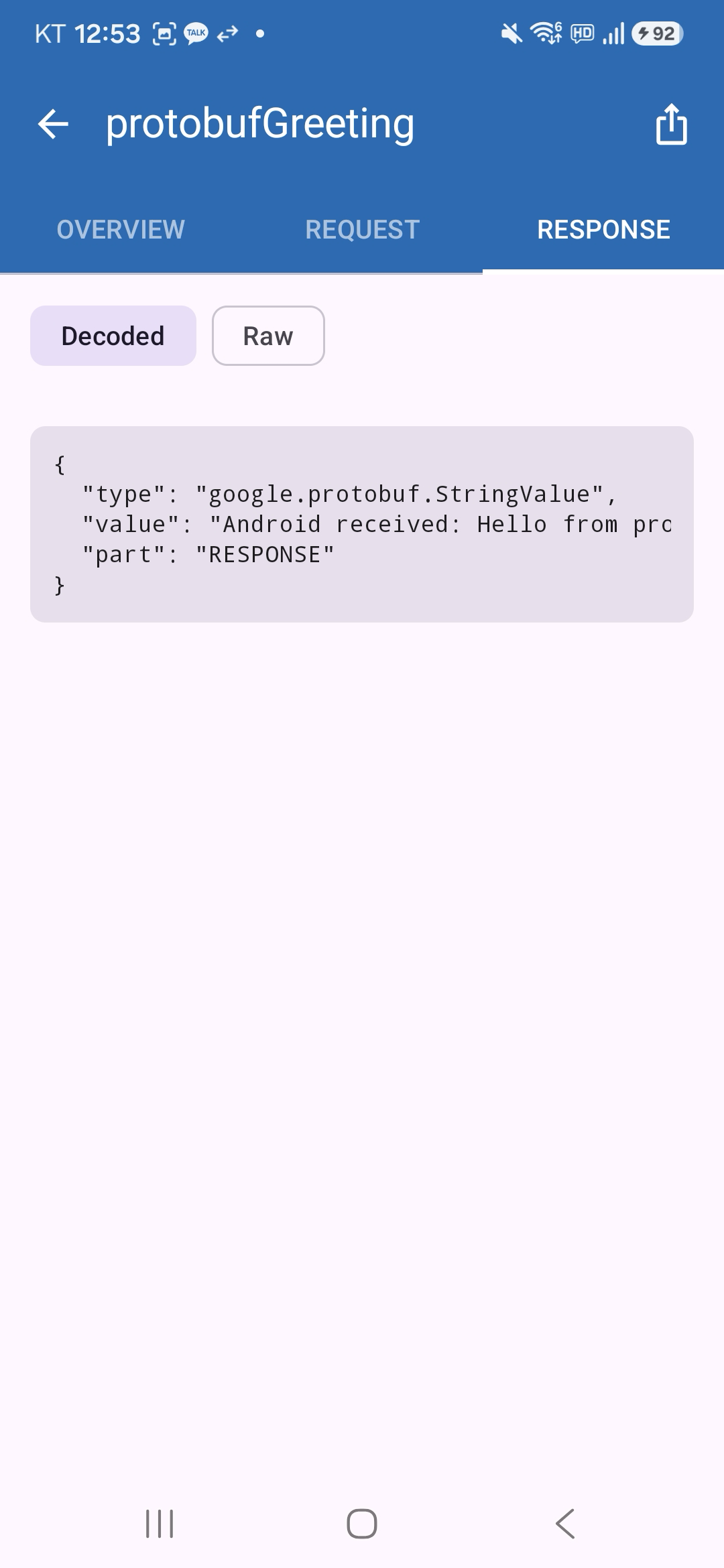 | 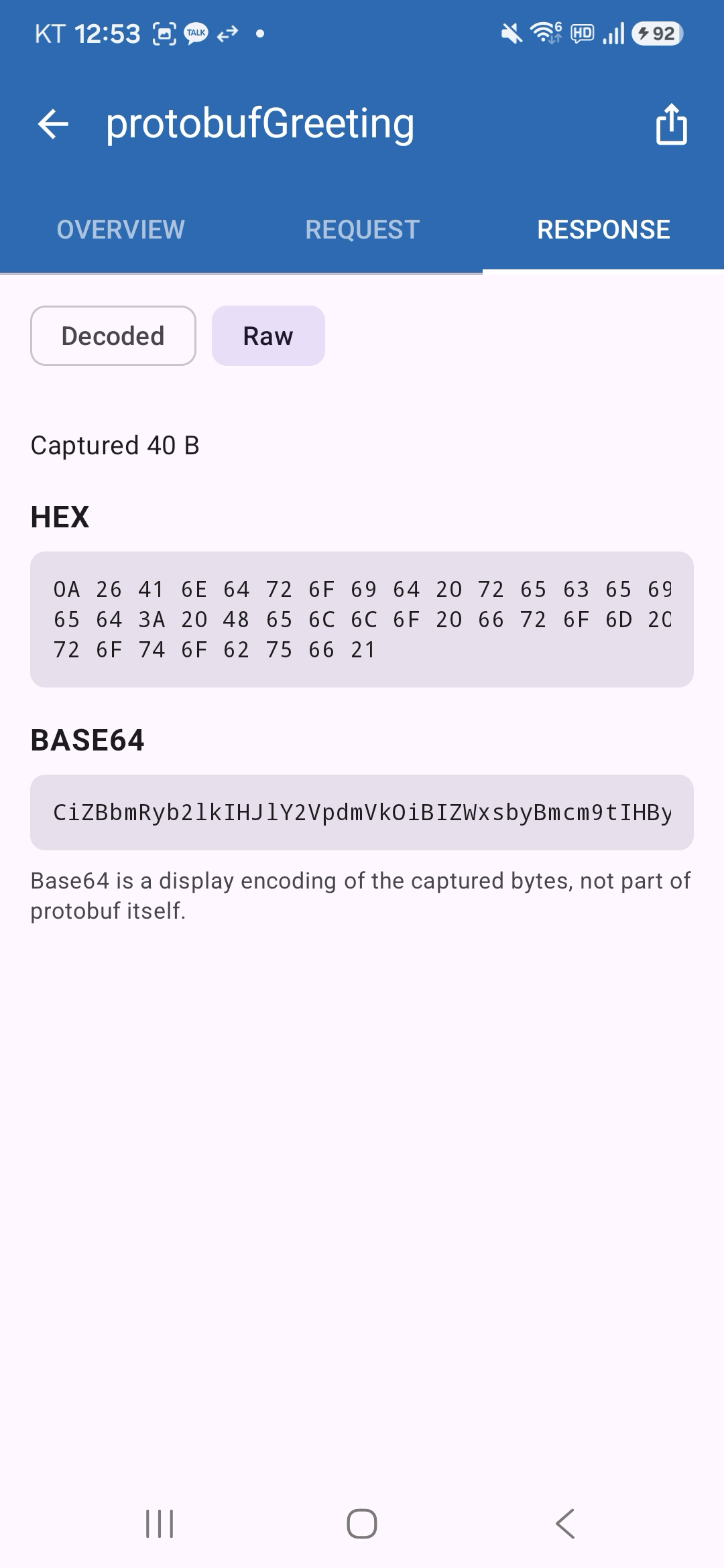 |
The screenshots show the RESPONSE tab; the REQUEST tab provides the same two views. Dari records the original byte size and decode status. The raw capture is limited to the first 4 KB, and larger payloads are marked as truncated. Decoder failures are recorded without interrupting bridge communication.
Runtime behavior
- Decoding runs synchronously on the interceptor caller's thread, so keep parsing and display conversion bounded.
- Release builds use
dari-noop;Dari.createInterceptor()returnsnull, and safe calls have no runtime overhead. - Existing String/JSON calls can continue on the same protobuf-capable interceptor.